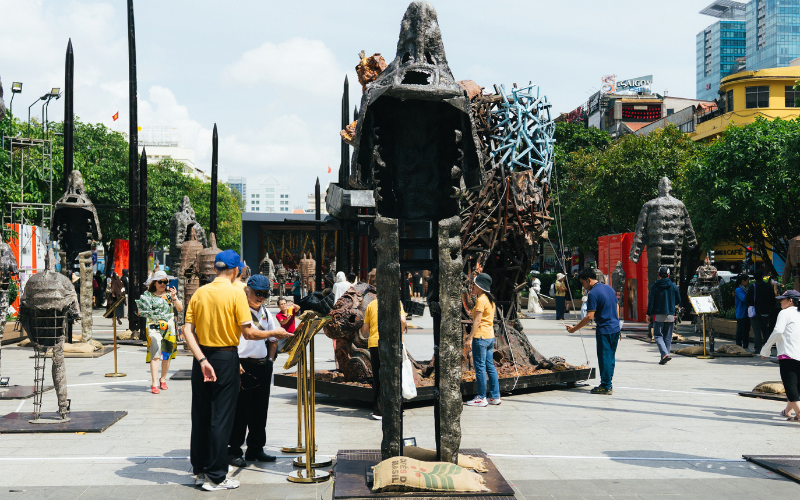
An Installation by Lê Hữu Hiếu and a Space for Dialogue on Urban Memory
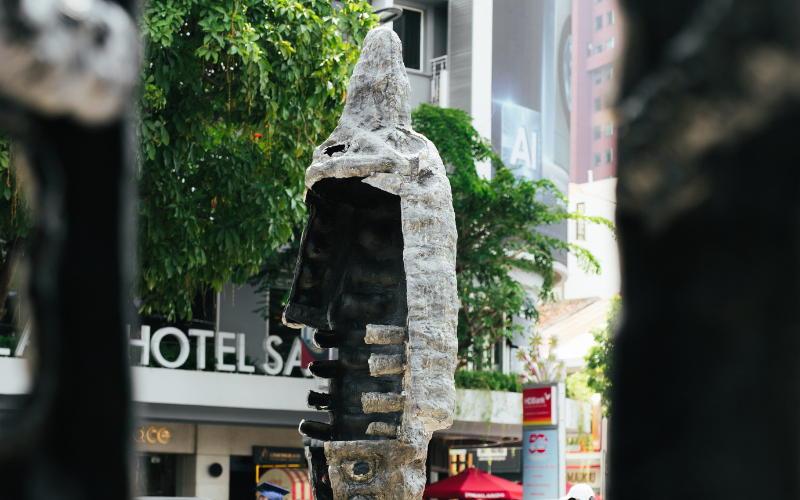
A sculptural mass.
No name. No introduction. No boundaries.
Yet in the middle of Nguyễn Huệ Pedestrian Street—where everything seems hurried, forward-looking, and relentlessly modern—the installation compelled people to stop. To look. To ask themselves:
“What am I walking through? And is there still a place for memory in this city?”
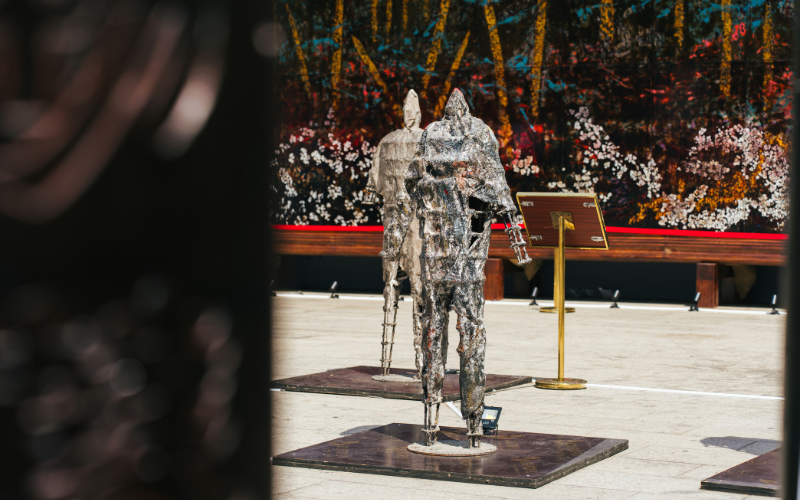
Art Is Not Meant to Illustrate History—But to Reopen the Question
The exhibition “From the Victory of Bạch Đằng to the Great Victory of April 30, 1975” bears little resemblance to any commemorative monument previously seen in Vietnam.
It does not name individual heroes.
It does not carve victories into stone.
It does not raise flags.
Instead, it presents a procession—a silent flow of human figures moving through centuries, from the Battle of Bạch Đằng in 938 to the spring of 1975.
Here, art does not narrate.
Art provokes questioning.
Are victories alone enough to define a nation?
Does memory require monumental grandeur—or merely a modest, honest presence in public space, just sufficient to confront us?
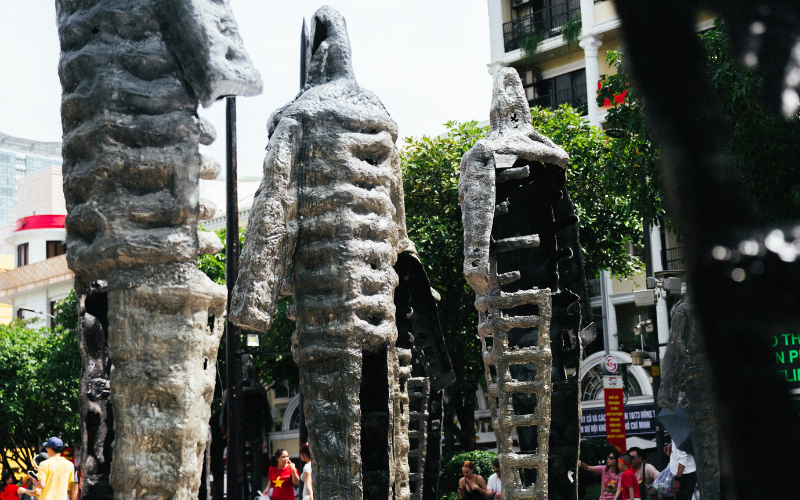
Creating an Emotional Void Where Dialogue Begins
Rather than reconstructing historical images, Lê Hữu Hiếu constructs a psychological space—one in which each viewer must complete the narrative using their own memories.
It is precisely within this emotional void, this deliberate absence of explanation, that dialogue begins.
Public Space: Where Memory Is No Longer Confined to Museums
Choosing Nguyễn Huệ Pedestrian Street as the site of the installation was both a bold and subtly political act.
This is not a museum.
There are no white walls.
No curators guiding interpretation.
It is a space of everyday life—where people commute, take children to school, take photographs, and stroll without agenda.
By appearing here—without barriers, without elevation—the sculpture forces memory to share living space with the present. No longer preserved behind glass, memory becomes part of the city’s breath, woven into the movement of today’s crowd.
This is why the work moved so many.
A motorbike taxi driver stopped and stood still for ten minutes.
A university student wrote online: “This is the first time I’ve seen history made this alive in a public space with no ticket required.”
GreenMoss Leather: Accompanying Art as a Cultural Act
As the principal sponsor, GreenMoss Leather did not enter the exhibition with loud branding or commercial presence.
We approached this project as an opportunity to do what we have always believed in: contributing to the expansion of cultural and aesthetic dialogue within Vietnamese living spaces.
As a materials brand, we understand that:
Aesthetics are not merely about surface choices—they are about how people live within space and history.
Supporting a non-commercial public art project is not an easy choice.
But it is precisely through such choices that GreenMoss affirms its role—not merely as a material supplier, but as a participant in shaping contexts: living contexts, emotional contexts, cultural contexts.
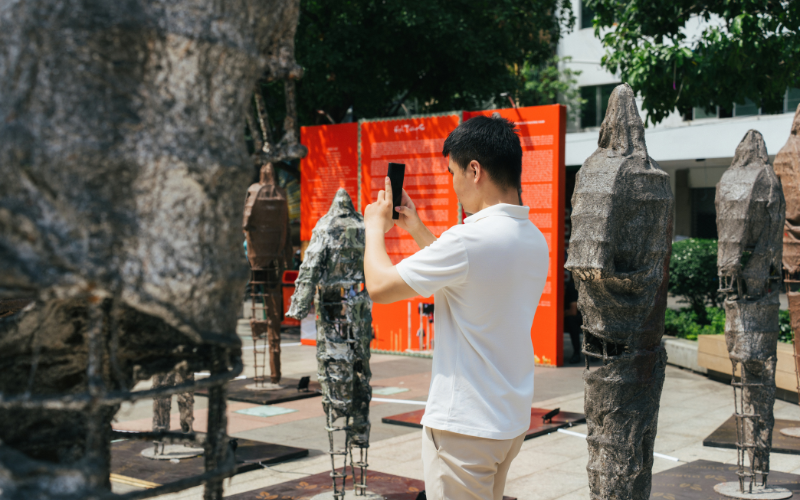
After the Sculpture: When Art Becomes Shared Memory
The exhibition concluded after two weeks.
But images of the installation continue to circulate online.
Conversations beneath those images continue to unfold.
Most tellingly, many people began to ask:
“When will the next exhibition take place?”
This reveals a simple truth:
Art does not need to explain or illustrate.
Placed in the right space, at the right time, with the right spirit—it lives.
The Sculpture Has Left the Street, but the Question Remains
“From the Victory of Bạch Đằng to the Great Victory of April 30, 1975” was not merely an art event.
It was a question posed in the middle of the city:
Is there still room for memory in urban life?
Can we create spaces where modern citizens coexist with history?
GreenMoss Leather is proud to have accompanied that question.
And we believe that in an era where beauty is often defined by spectacle and market share, choosing a quiet yet profound work of art is itself a declaration of aesthetic integrity.
GreenMoss — not only a material for space, but a material for memory.