
- 1. The Silent Journey Behind a Perfect Hide
- 2. From Raw Hide to Refined Grain — Where Technique Begins
- 3. The Art of Tanning — Where Science Meets Sensibility
- 4. Dyeing — When Color Becomes a Language
- 5. Surface Finishing — Texture, Sheen, and Touch
- 6. Inspection & Classification — Italian Standards, Global Commitment
- 7. Craftsmanship 4.0 — When Hands, Data, and Technology Converge
- 8. GreenMoss — The Storyteller of Materials
1. The Silent Journey Behind a Perfect Hide
A piece of Italian bovine leather that meets international standards is never the result of chance.
It is the outcome of a journey that spans several weeks—where engineering, science, artistry, and sustainability philosophy converge.
Behind the smooth, warm, and consistent surface lie dozens of meticulous, largely invisible processes: from raw hide selection and biological treatment to tanning, dyeing, finishing, and final inspection.
Each step is a form of anonymous craftsmanship—demanding experience, time, and emotional sensitivity—something only leading Italian tanneries can truly master.
“To create a perfect hide, a craftsman must be both an engineer and an artist.”
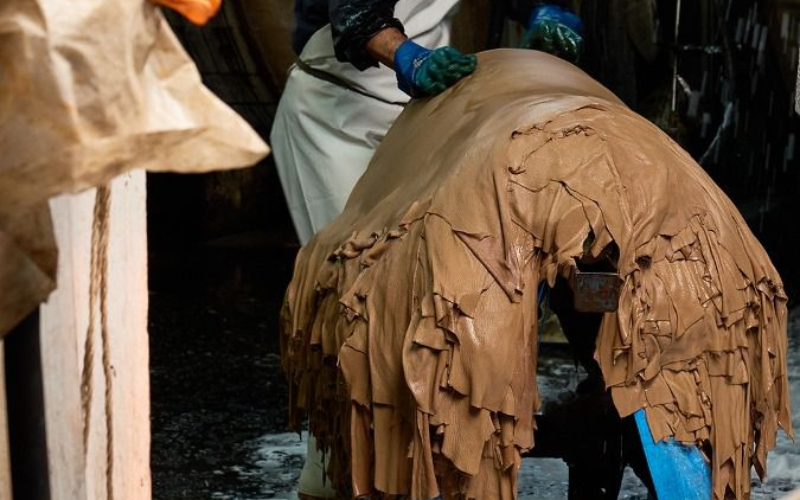
2. From Raw Hide to Refined Grain — Where Technique Begins
Every journey starts with raw material.
At GreenMoss Leather, every Italian hide is sourced from top-tier tanneries in Italy, where production is tightly controlled under international standards for quality, traceability, and sustainability (LWG Gold Rated).
The selection process focuses on:
Naturally raised European cattle (cool climates, thicker hides, fewer parasites)
Full hides, never patched or assembled
Manual inspection under angled light to eliminate structural defects
The hides then undergo curing (salt preservation) and soaking, preserving the natural collagen structure—an essential factor for long-term durability and elasticity.
3. The Art of Tanning — Where Science Meets Sensibility
Tanning is the soul of leather craftsmanship.
It is the stage where perishable raw hide becomes a durable, supple material resistant to moisture and time.Three primary tanning methods are widely used in Italy:
Chrome Tanning
Fast and stable, producing soft leather suitable for sofas and high-traffic public interiors.Vegetable Tanning
Using plant-based tannins, requiring longer processing time and yielding leather with natural aroma and beautiful patina.Kind Leather (Hybrid Tanning)
Combining chrome efficiency with vegetable principles, reducing water and energy consumption by up to 65%.Italian technicians often say:
“Tanning is not just chemistry—it is how we give a soul to the material.”
Each hide passes through rotating drums where temperature and pH are controlled to the minute and the decimal. Even minor deviations can cause stiffness or micro-cracking.
4. Dyeing — When Color Becomes a Language
After tanning, the hides enter the through-dyeing stage, which defines tone, depth, and visual emotion.
GreenMoss leathers are dyed using aniline or semi-aniline dyes, allowing pigments to penetrate deep into the fiber structure rather than forming a surface layer.
The result is a living color—subtly shifting with light and time.Earth tones such as Champagne, Olive, Bistre Terra, or neutrals like Taupe and Cream, are created not only by pigments, but by the interaction between dye and the hide’s natural base. Each batch becomes a unique shade.
“No two hides share the same color—this is the definition of natural luxury.”
5. Surface Finishing — Texture, Sheen, and Touch
Finishing is where Italian craftsmanship becomes most visible—and tangible.
Techniques such as milling, spray coating, and hand polishing are used to achieve specific surface effects:
Leather Type Finish Characteristics Tactile Feel Typical Applications Aniline No top coat, natural sheen Soft, warm, organic Luxury villas, sofas Semi-Aniline Light protective coating Smooth, refined High-end apartments Pigmented / Corrected Grain Protective finish, stain-resistant Firm, easy-care Hospitality, offices
At this stage, craftsmen assess grain uniformity and tactile feedback.
Only when both aesthetic quality and handfeel meet strict criteria is the hide approved for release.
6. Inspection & Classification — Italian Standards, Global Commitment
Before reaching GreenMoss, each hide undergoes rigorous testing:
Thickness: measured with micron gauges (±0.1 mm)
Tensile strength: compliant with EN ISO 3376
Abrasion resistance (Martindale): >50,000 cycles (hospitality-grade)
Fire resistance: EN 1021-1/2, mandatory for public spaces
Color fastness (crocking & fade tests): Grade 4–5, EU standard
All data are documented in a Certificate of Quality & Conformity, accompanying each batch upon arrival at GreenMoss warehouses in Ho Chi Minh City.
Through parallel quality control systems in Italy and Vietnam, GreenMoss ensures consistency, stability, and nationwide delivery within 24–48 hours.
7. Craftsmanship 4.0 — When Hands, Data, and Technology Converge
Behind every perfect hide is not only skilled hands, but also data and technology.
At GreenMoss, each leather batch is digitally traceable via QR codes, recording:
Hide origin
Tanning, dyeing, and finishing processes
This approach reflects Craftsmanship 4.0—where traditional skill meets digital intelligence, enhancing transparency and reducing environmental impact.
“Perfection today comes not only from hands, but from how we manage every detail through data.”
8. GreenMoss — The Storyteller of Materials
For GreenMoss, bringing Italian leather to Vietnam is not merely a commercial activity.
It is a way of retelling the story of global craftsmanship within a modern Vietnamese context.Through its showroom network, international-standard warehouses, and technical consulting team, GreenMoss helps architects and contractors understand materials in depth—from origin to application—transforming leather from a surface into a meaningful design narrative.