- 1. Genuine Leather: A Fibre-Based Material, Not a Uniform Surface
- 2. Where Natural Marks on Leather Come From
- 3. Types of Natural Marks and How They Form
-
- 3.4. Grain Break: Disruption of the Surface Structure
- Formation Mechanism
- Unlike natural marks such as healed scars or back marks, this type of mark appears when the grain layer is structurally damaged. Possible causes include: Deep damage before tanning, such as bites or strong impact Mechanical stress during production, including pulling, cutting, or shaving Physical damage after finishing, such as sharp objects or concentrated pulling force When this happens, the collagen fibres in the grain layer are no longer continuously connected. This can lead to: → An open surface → Exposed internal fibre structure
- How to Identify It
- This type of damage can usually be distinguished from natural marks through several signs: A visible open edge that does not close naturally Edges that appear “broken” rather than blended into the grain Visible exposure of the lower layer or pulled fibres A tendency to spread further under tension Unlike a healed scar, grain break is not structurally stable and is not considered a natural characteristic of the material.
- 3.4. Grain Break: Disruption of the Surface Structure
- 4. The Role of Finishing in the Visibility of Natural Marks
- 5. Mechanical Impact of Natural Marks
- 6. Differences Between Hide Areas in Upholstery Leather
- 7. Natural Marks and the Meaning of “Quality”
- 8. Conclusion
- GREENMOSS
1. Genuine Leather: A Fibre-Based Material, Not a Uniform Surface
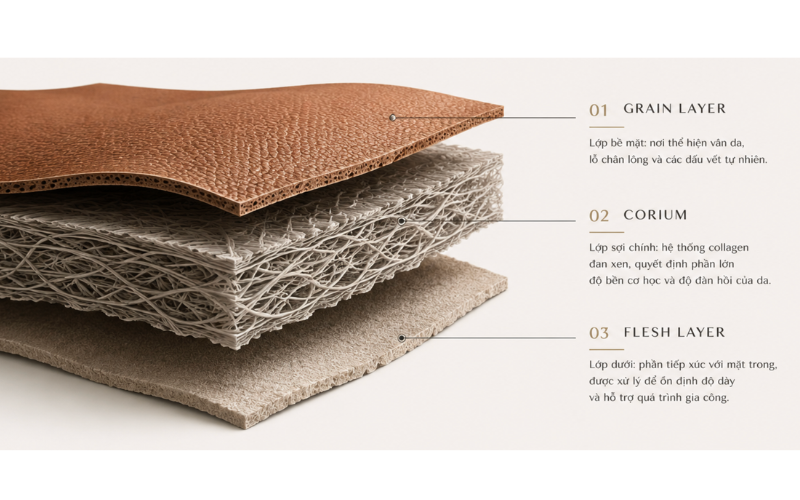
After tanning, genuine leather does not become a flat, uniform coating. It remains a three-dimensional network of interwoven collagen fibres.
This structure consists of several layers:
- Grain layer: the surface layer where natural grain, pores, and visible marks appear
- Corium: the main fibre layer, where interwoven collagen fibres provide much of the leather’s mechanical strength
- Flesh layer: the underside of the hide, which is processed to stabilise thickness and prepare the leather for use
Collagen fibre bundles are not perfectly parallel. Their density varies across different areas of the hide, and their direction changes depending on the part of the animal’s body.
As a result, the surface of leather cannot be separated from the structure beneath it. The marks seen on the surface are often direct expressions of the internal fibre arrangement.
2. Where Natural Marks on Leather Come From
Before becoming an interior material, leather was once part of a living body. During growth and movement, the hide was affected by several natural factors, including:
- Mechanical movement such as bending, stretching, and twisting
- Body growth and skin expansion
- Environmental contact, including impact and insects
- The body’s biological healing process
These factors can create:
- Healed scars
- Stretch marks
- Veins and wrinkles
- Irregularities in the grain
- Subtle tonal variations
These marks are organic in nature. They do not follow a repeated pattern, and they form part of the material’s natural character.

3. Types of Natural Marks and How They Form
3.1. Wrinkles and Veins
Formation Mechanism
Wrinkles and veins often appear in areas that experience repeated movement, such as the neck, shoulder, or flank.
In these areas, collagen fibre bundles are repeatedly bent and shifted, which can lead to:
- Localised reorientation of fibres
- Visible vein-like lines or wrinkles on the surface
Material Characteristics
- Higher softness compared to the butt area
- Better natural drape
- A more dimensional interaction with light
Wrinkles and veins are not necessarily flaws. In many cases, they add depth and a more natural visual character to the leather surface.
3.2. Healed Scars
Formation Mechanism
When the skin is injured, the body activates a natural healing process. New collagen is produced to repair the affected area. However:
- This new collagen does not always follow the exact direction of the original fibre structure.
- This can create a localised area of fibre discontinuity.
Material Characteristics
- Feel slightly different in elasticity or firmness
- Remain limited to a small area
- Become structurally stable after the tanning process

3.3. Stretch Marks / Back Marks
Formation Mechanism
Stretch marks appear when the hide is stretched during the animal’s growth. Collagen fibre bundles are extended beyond their original elasticity, creating:
- Long linear marks
- Minor changes in the fibre structure
- Subtle variation in the surface appearance
Material Characteristics
- Not cracks
- Already stabilised deformations
- Often associated with tonal variation on the leather surface
Aesthetic Value
Back marks can bring a natural and expressive quality to leather, especially in designs that highlight material authenticity and surface depth.

3.4. Grain Break: Disruption of the Surface Structure
Formation Mechanism
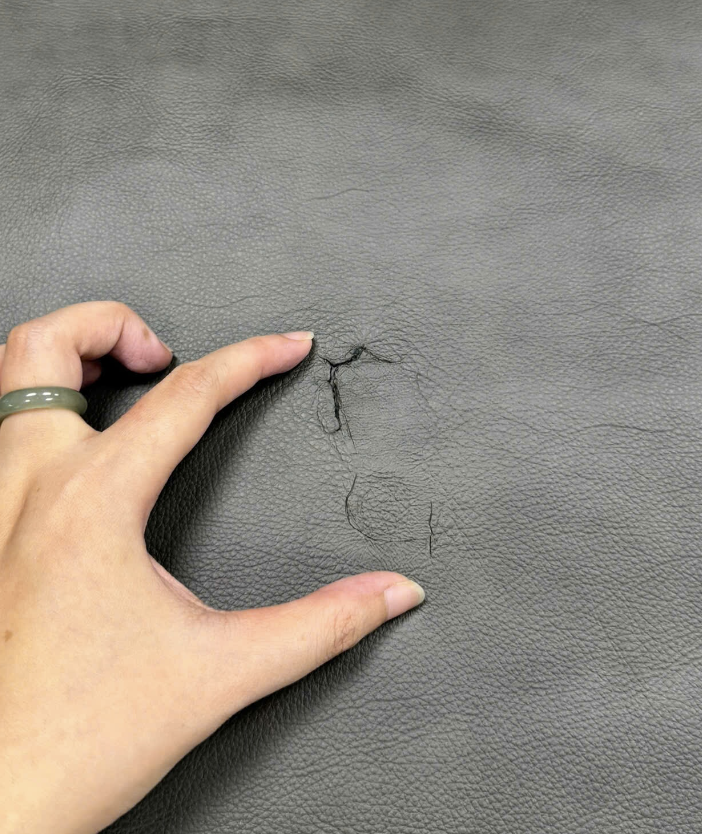
Unlike natural marks such as healed scars or back marks, this type of mark appears when the grain layer is structurally damaged.
Possible causes include:
- Deep damage before tanning, such as bites or strong impact
- Mechanical stress during production, including pulling, cutting, or shaving
- Physical damage after finishing, such as sharp objects or concentrated pulling force
When this happens, the collagen fibres in the grain layer are no longer continuously connected. This can lead to:
→ An open surface
→ Exposed internal fibre structure
How to Identify It
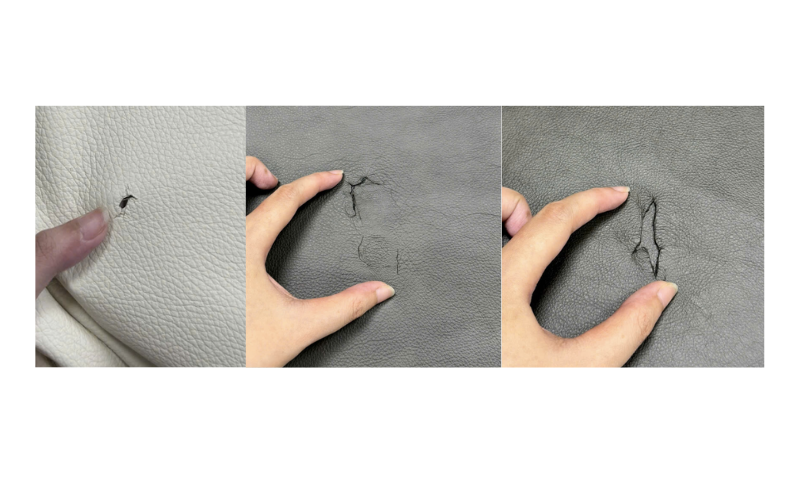
This type of damage can usually be distinguished from natural marks through several signs:
- A visible open edge that does not close naturally
- Edges that appear “broken” rather than blended into the grain
- Visible exposure of the lower layer or pulled fibres
- A tendency to spread further under tension
Unlike a healed scar, grain break is not structurally stable and is not considered a natural characteristic of the material.
4. The Role of Finishing in the Visibility of Natural Marks
The visibility of natural marks depends greatly on the surface finishing of the leather.
| Leather Type | Visibility of Natural Marks | Characteristics |
|---|---|---|
| Aniline | Very high | Minimal surface coverage, preserving the natural grain |
| Semi-Aniline | Medium | Light finish, balancing natural appearance and surface stability |
| Pigmented | Low | Pigment coating covers much of the surface |
A basic principle applies:
Mức độ giữ tự nhiên càng cao → dấu vết càng rõ
The more natural the surface is kept → the more visible the natural marks will be.
This does not indicate poor quality. Instead, it reflects a lower level of intervention on the material surface.
5. Mechanical Impact of Natural Marks
Natural marks usually have several common characteristics:
- They are localised
- They do not continue to spread
- They do not destroy the entire fibre structure
For this reason, in most cases, natural marks do not significantly affect the overall durability of the leather.
However, several factors still need to be considered:
- The position of the mark
- The level of stress applied to that area during use
- The characteristics of the hide section, such as butt, shoulder, or belly
The combination of these factors determines whether a particular piece of leather is suitable for a specific application.
6. Differences Between Hide Areas in Upholstery Leather
Cowhide is not structurally uniform across its entire surface. Each area has its own fibre arrangement and mechanical behaviour.
Butt area
- Thicker collagen fibres
- More defined fibre orientation
- Higher structural stability
Shoulder / Hump
- Multi-directional fibres
- Greater flexibility
- More visible natural marks
Belly
- Looser fibres
- Lower structural stability
- A higher tendency to stretch or deform
Selecting the right hide area for each part of an interior product is essential for achieving both aesthetic quality and long-term durability.
7. Natural Marks and the Meaning of “Quality”
In industrial materials, quality is often associated with absolute uniformity.
With genuine leather, however, quality needs to be understood differently.
The quality of genuine leather depends on:
- The collagen fibre structure
- The tanning and finishing process
- Mechanical stability
- The degree to which natural characteristics are preserved
A completely uniform surface is often the result of stronger interventions such as sanding, embossing, or heavy pigment coating. By contrast, leather surfaces that retain natural marks often indicate a lower level of surface correction and a greater preservation of the material’s original structure.
8. Conclusion
Marks such as scars, back marks, veins, wrinkles, and subtle surface variations are not simply defects. They are the result of:
- Collagen structure
- Natural growth
- Mechanical movement
- Surface finishing choices
They should be evaluated based on:
- Their structural nature
- Their mechanical impact
- Their position within the final product
- The aesthetic requirements of the design
Understanding these factors allows leather to be used more accurately and responsibly. It also allows genuine leather to be appreciated not merely as a finished surface, but as a material system with depth, structure, and natural character.
GREENMOSS
GreenMoss offers a wide range of leathers, from Aniline and Semi-Aniline to Pigmented leather, each preserving natural characteristics to a different degree.
Each hide is selected not only for its colour, but also for its structure, surface character, and suitability for specific interior applications.
References:
Leather Technologists Pocket Book - J.H. Sharphouse
The Chemistry of Leather Manufacture - K.H. Gustavson
Leather Working Group (LWG)