
- Memory Does Not Live Only in History Books — When a Pedestrian Street Becomes a Living Museum
- Aluminum — A Lightweight Material Carrying Heavy Memory
Memory Does Not Live Only in History Books — When a Pedestrian Street Becomes a Living Museum
A space without a name.
Without walls.
Without staging.
Only memory—silent, immobile, yet unmistakably present.
The installation exhibition “From the Victory of Bạch Đằng to the Great Victory of April 30, 1975” did not take place in a museum.
It was not enclosed in a controlled gallery, nor accompanied by large explanatory panels.
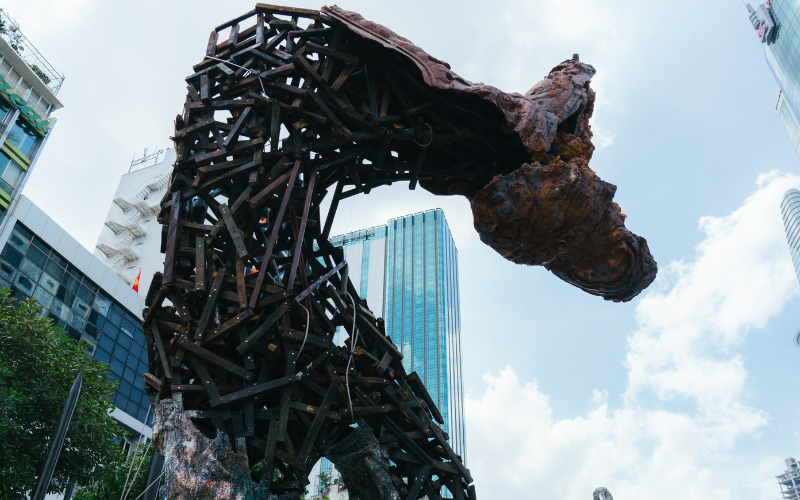
Instead, massive sculptural forms appeared in the middle of Nguyễn Huệ Pedestrian Street—interwoven with the everyday flow of millions of people—whispering, and at times resounding, with questions about memory, history, and how we engage with the past.
Aluminum — A Lightweight Material Carrying Heavy Memory
Rather than bronze, steel, or wood—materials traditionally associated with monuments—artist Lê Hữu Hiếu chose aluminum.
This decision was not merely technical—lighter weight, easier installation, suitable for outdoor display—but deeply symbolic.
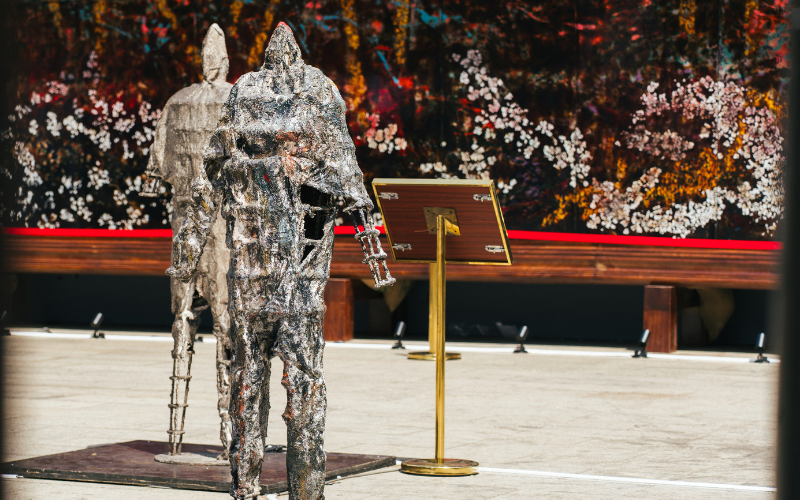
Aluminum is a material of modernity, widely used in industry and contemporary architecture. By shaping historical figures in aluminum, the artist seems to suggest that history is not something confined to museums—it exists within the city itself, continually reshaped by technology and by the hands of the present, in order to keep living.
These aluminum sculptures may lack the physical heaviness of bronze, yet they carry enough emotional weight to make passersby slow their steps.
Public Space as an Open Museum
Walking among the monumental forms on the pedestrian street, visitors received no brochures, no maps, no prescribed route.
No definitive captions were attached to the works.
No emotional instructions were given, as is common in contemporary galleries.
And no one demanded silence.
This was a deliberate visual strategy: to allow each person to arrive at their own understanding.
A child climbs onto the tank tracks.
An elderly man stares fixedly at a sculpted aluminum face.
A young couple takes a selfie beside a monumental lacquer-like panel.
Each person leaves with a different experience—just as memory itself is never uniform, yet always deserves space to exist.
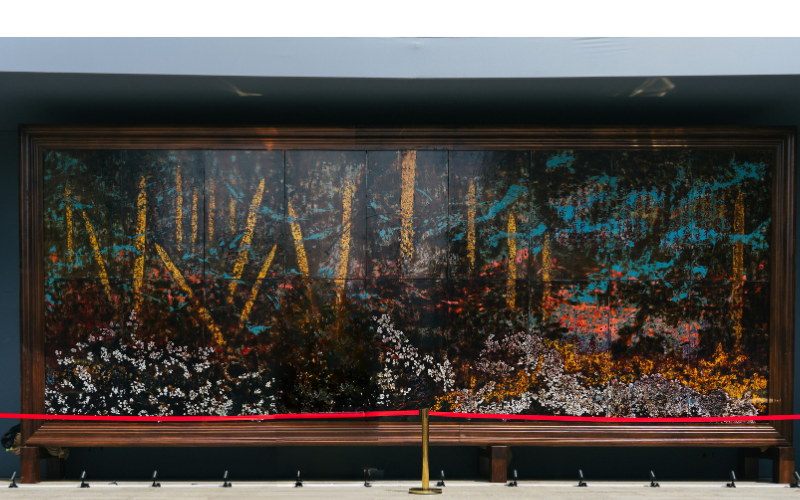
For a long time, public monuments have been associated with solemnity and rigid conventions. What this exhibition offered ran counter to that tradition.
There was no fixed monument.
No attempt to impose a singular message.
No requirement to perform reverence.
Instead, it opened up ambiguity.
It did not force remembrance—it granted freedom of perception.
GreenMoss Leather and a Commitment to Collective Memory
For GreenMoss—a brand specializing in premium leather materials for interior design—supporting this exhibition was not a conventional PR gesture.
It was a way of affirming a belief: every material carries memory, and every business has a role to play in preserving the memory of the community it inhabits.
If aluminum became a medium for narrating history, then leather—with its textures, marks, and the patina of time—is also a material that evokes lived memory. By accompanying contemporary art, GreenMoss does not merely participate in the aesthetic market, but contributes to a broader cultural dialogue—about identity, shared values, and how we imagine the future through the lens of the past.
One Exhibition, Many Layers of Reflection
Some describe the exhibition as “an occupation of public space through art.”
Others see it as “an attempt to reactivate national memory within a modern city.”
Some do not fully understand it—yet still stand there for a long time.
Regardless of interpretation, the presence of the aluminum sculptures, the quiet or overwhelming emotions they provoke, and the absence of physical boundaries have achieved something rare:
They transformed public space into a living museum of memory.