
Vietnam's furniture market is growing steadily, but not every segment is growing at the same pace. According to compiled market data, the premium furniture segment is projected to grow at roughly 8.87% per year between 2026 and 2031, while the hospitality application segment (hotels, resorts) is expected to grow at around 8.76% per year — both outpacing the furniture industry's overall growth rate. This is precisely the segment where premium cowhide leather has the most room to grow.
Why Are Villas, Penthouses, and Boutique Hotels the Right "Playing Field" for Leather?
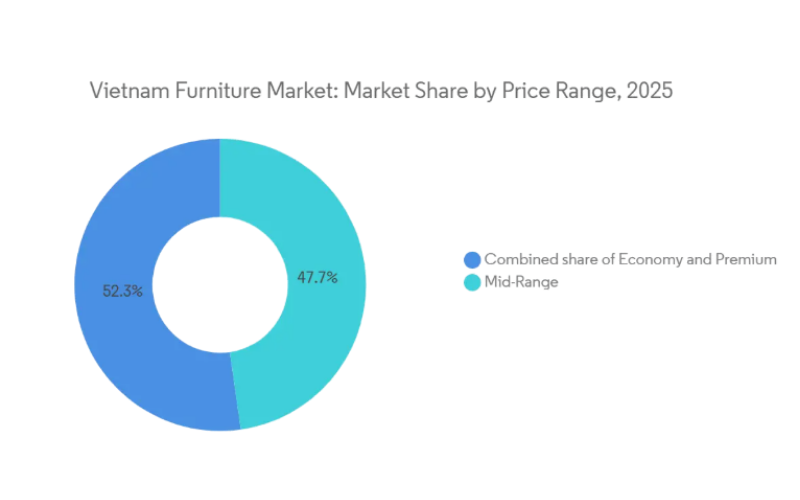
In the mass-market and mid-range housing segment (accounting for nearly 48% of market share by value), buyers prioritize cost optimization and tend to choose more affordable materials. In contrast, villas, penthouses, branded residences, and boutique hotels — where architects and designers are involved — treat materials not just as functional elements but as tools to elevate a property's positioning. This is why genuine cowhide leather, with its distinctive tactile quality and material story, fits naturally into this segment rather than competing on price in the mass market.
Penthouse — Kitchen Island and Bar Area The pairing of a stone kitchen island, cognac-colored leather bar stools, and leather-wrapped handles is a典型example of material styling in a high-end penthouse: stone provides durability and visual appeal, while leather adds warmth and luxury at frequently touched points. Boutique Hotel — Reception and Lounge
A stone reception counter combined with leather lounge chairs and wood veneer panels is a popular material formula for boutique hotels aiming to make an impression from the moment guests arrive — where first impressions of service quality are formed.
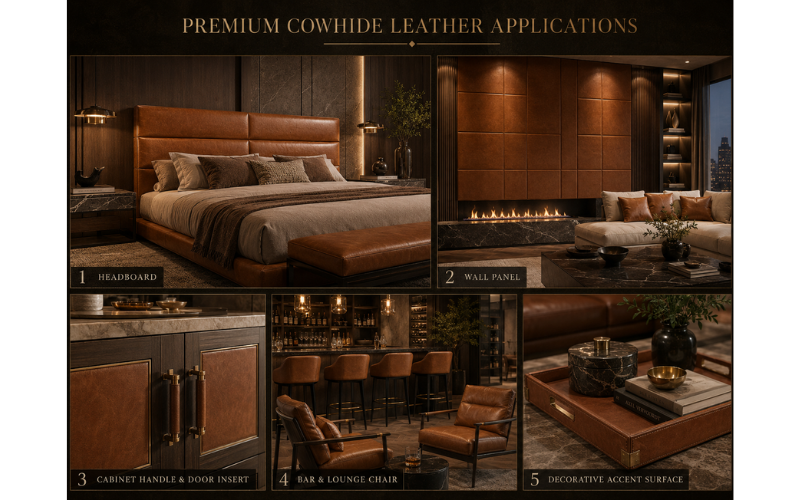
- Headboards in villa/penthouse master bedrooms
- Decorative wall panels in lounges and living rooms
- Cabinet handles and door inserts
- Bar stools and lounge chairs in entertainment areas
- Decorative surfaces at key design focal points
Why Target Renovation Projects, Not Just New Builds?
One important point: the hotel/resort sector is recovering strongly post-tourism-slump, and many existing properties are now in the process of upgrading or repositioning rather than building new. In renovation projects, demand for high-quality interior materials tends to emerge faster and carry more decisive weight than in new-build projects, since owners need to differentiate immediately to compete in an already-saturated market.
Conclusion
The villa, penthouse, branded residence, and boutique hotel segment isn't the largest market by volume — but it's where premium cowhide leather can compete on its true strengths: authentic feel, material storytelling, and the ability to elevate a space's positioning, rather than competing on price against industrial leather in the mass market.
If you're an architect, designer, or investor developing a premium project and need leather material guidance tailored to specific applications, contact GreenMoss for technical consultation and real material samples.
References Intelligence,